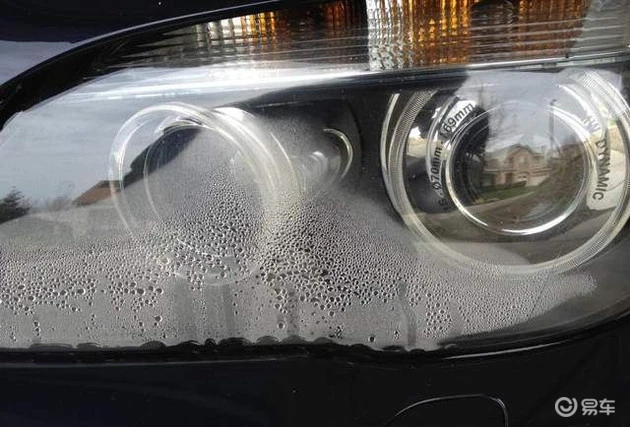
How fog inside the headlight form?
Some car owners should have encountered fogging inside the headlights. In our opinion, the inside of the headlights is completely enclosed, so the fogging inside the headlights can basically be regarded as a quality problem.
In fact, car headlights do fog up under certain special circumstances, but it is not necessarily a quality problem. But the probability of this situation is very low. Today we will take a look at why there is fog inside the headlights.
1. The headlights are not completely sealed and have ventilation holes
Because the headlight generates a lot of heat when it is working, if the headlight is completely sealed, its internal pressure will increase, which will affect the life and stability of the headlight.
Therefore, the back cover of the headlight assembly has a pressure-balanced vent. Generally, the vents are distributed up and down, ranging from two to four. When the headlight is working, the internal temperature rises, the high-temperature gas flows upward and is discharged from the upper air vent, while the external cold air enters the headlight from the lower air vent. This cycle keeps the internal pressure balance of the headlights.
2. With vents, water vapor may enter the headlights to produce fog
Since there is a vent, the gas continuously circulates when the headlight is working, which may cause the moisture in the outside air to enter the inside of the headlight. When the headlight is working, the temperature inside the lampshade is very high, and the moisture fills the lampshade in the state of water vapor. The temperature gradually drops after turning off the headlights. Because the lampshade is directly exposed to the outside of the car head, the temperature of the lampshade drops the fastest, and water vapor will condense into small water droplets inside the lampshade, causing fogging.
The headlight vent is not done by opening a hole directly, but in a semi-closed state, which can prevent excessive dust and water vapor from entering the headlight. Therefore, it is not easy for the external air to enter the lampshade without pressure when the headlight is not working. Generally speaking, only when the headlight is working, water vapor is the easiest to enter the interior of the headlight with the gas circulation. For example, if you drive with the headlights on in a very humid weather, water vapor will easily enter the headlights and cause fog after the flame is turned off.
The headlights are poorly sealed, for example, the sealant between the lampshade and the shell is opened, and the headlights are damaged.
The vent is damaged, causing unrestricted air circulation between the inside of the headlight and the outside world.
The headlights were not properly closed after modification. The most common is to change the LED bulb. Because of the large size of the LED bulb, an extended dust cover needs to be installed, and it is not properly sealed. At this time, water vapor and dust can easily enter the interior of the headlight.